“I hate retirement annuities," say investors. Here’s why they're wrong.
10 October 2024
The uncomfortable truth about retirement in South Africa - Rands and Sense by 10X [video]
We sit down with 10X Investment Consultant lead Andre Tuck and discuss the retirement savings crisis in South Africa. We also delve into living annuities, retirement annuities, TFSAs and everything in between. Read more
![The uncomfortable truth about retirement in South Africa - Rands and Sense by 10X [video]](/_next/image?url=https%3A%2F%2Fimages.ctfassets.net%2Fyqvz0zwovkbq%2F5ipSTnRq5Dp25fyghm5kGQ%2F02c801c78d5e1ca9280bfd34d7602368%2FAndre_Tuck_podcast_cover_image__1_.webp&w=828&q=75)
10X Investment Consultant Michael Rossouw has spoken to thousands of investors over the past decade and all too often he hears the words, “I hate retirement annuities - there's so much wrong with them!”
Which is strange, as many in the industry will tell you an RA is one of the best long term investment options. So why the dissonance? Why is it that investors feel this way about retirement annuities? Michael’s take is that it boils down to the following key issues.
Did you know you can speak directly to Michael about your retirement planning? There are no call centres at 10X, just experienced professionals ready to help. Simply get in touch.
'Where are my returns?' Is poor investment management the norm?
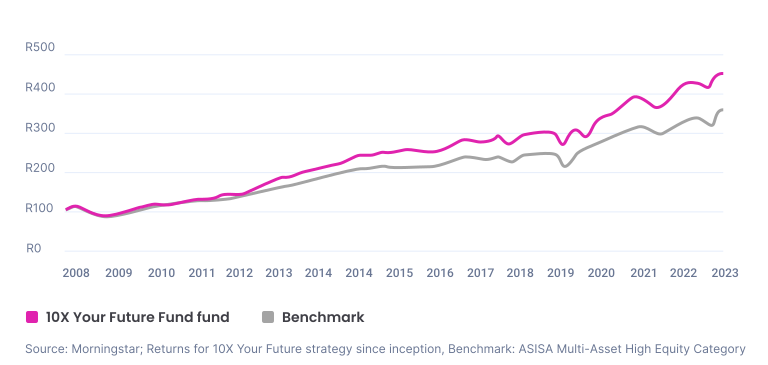
Unfortunately, the management of retirement annuity investments has traditionally been poor, with many funds underperforming against market returns. According to SPIVA, over the last 10 years, 94% of funds have underperformed the S&P South Africa Composite Capped Index. At 10X, we help investors compare their returns to the market to see if they are having investment management problems and to discuss whether 10X can improve that situation.
'But I can't get my money till I'm retired!' The flexibility myth
Many investors see RAs as not offering the right level of access or flexibility in investment choices. Generally, those concerns sound something like the following:
- I have no access to those funds until I'm 55
- I can't take all my money as cash when I retire
- I must use two-thirds of that money to invest in a living annuity or a life annuity, or a combination of the two
Let's work through these in turn.
- You do, in fact, have some access to those funds via the two-pot legislation passed in September 2024. You can withdraw as much as you you like from your savings pot (as long as you have more than R2000 rand in there). But, you will be taxed at your income tax rate on those funds, and, importantly, anything you draw from there reduces the one-third cash amount you can take from your RA when you retire. The important point a lot of people miss here is that while you have limited access to your RA funds, your creditors have no access whatsoever (which is not the case with discretionary investments like a unit trust or a TFSA - a court can order you to cede those funds to a creditor). Worth thinking about that, isn't it?
- It's true that you can't take all your money as cash when you retire. The point is that RA funds in the form of an annuity income can be thought of as one part of your retirement income. If you want a larger pot of cash at retirement, you should consider splitting your investment between an RA and discretionary products like unit trusts or a TFSA.
- This is also true - you must choose to put two-thirds of your RA money into either a living annuity or a life annuity (or a combination of the two) at retirement. But consider that funds in a living annuity sit outside of your estate and can be left to your children (or other nominated beneficiaries) tax-free, and suddenly, a living annuity makes a lot of sense as a wealth transfer device.
Like any investment product, a retirement annuity has 'pros' and 'cons'. More important than focusing on any perceived 'cons' is understanding the trade-offs you're making when you invest in one. Because, like anything in life, there are definite 'pros' too!
Retirement Annuity vs Tax-free Savings Account vs Bond: Where Should Your Extra Money Go?
Got extra money to invest? Compare three powerful options: Retirement Annuity, Tax-Free Savings Account (TFSA), or paying off your bond faster. Learn the pros and cons of each to make an informed choice for your financial future. Read more

'How do I know my money is in the right place?'
If you are investing in a retirement annuity, you most likely have a long term investment horizon. Many investors tend to invest too conservatively, by over-investing in shorter term, more defensive assets such as cash and bonds. While that allows for less risk and volatility than equities, for example, the potential returns are lower, too. If you misallocate, you could receive lower returns. But if you take the time to correctly match your asset allocation with your investment horizon, you are more likely to receive a higher potential return over that period. Have a look at the different funds available through 10X to see how we think about asset allocation.
'But doesn't Regulation 28 limit my investment options?'
You can invest in growth assets like equities and put some of the money offshore, but regulation 28 of the pension funds act limits your exposure to equities to 75%, and you're only allowed to put 45% of your money offshore. Perhaps you feel like you would like more options than that, and furthermore, wouldn't you benefit from a more aggressive portfolio over a longer timeline?
The fact is that a retirement annuity is a tax-efficient wrapper designed to help you save for retirement. The mistake investors tend to make is only looking at investment returns, and forgetting to add the guaranteed tax return you get when contributing towards a retirement annuity. For example, if your investment return for a retirement annuity is a measly 1% you may think the RA is not worth your while. Yet, if you earn R1m and contribute R100 000 towards a retirement annuity, you will receive R41 000 (41%) tax return.
This results in a total return of 42% of which 41% was guaranteed by SARS irrespective of how the investment performed. Imagine what your total return could be if you improved the way it is managed, invested with the correct asset allocation and reduced your fees (more on the huge impact of fees further down).
Build the retirement of your dreams with our
Retirement Annuity calculator'Isn't the tax return a bit oversold?'
Some investors might feel that the tax return (or the total return) is oversold, because when you draw on your retirement annuity savings for income once you're retired (in the form of a living annuity or life annuity) you're taxed on that income. So what you get back on the RA now, you're going to pay later anyway.
But, what if there was a cleverer way? Read the article below, and you'll see that there is a way to ensure that the tax burden on your retirement income is at least somewhat offset by the tax-free income you can receive from a tax-free savings account (or TFSA, which is actually an investment product, and not a savings account at all).
Savvy RA investors let SARS fund their Tax-Free Savings Account (or their kid's one)
Being responsible with your retirement annuity (RA) could mean you get a maxed out tax-free savings account for free. Here's how. Read more

To return to the limits of regulation 28: you could put all your money into equities, or offshore, or offshore equities in the form of a unit trust or ETF. But, you're saving for the long term, so isn't diversification a good thing? In one sense, regulation 28 limits your investment options. In another sense, it ensures you don't overexpose yourself and take unnecessary risks with the money that should provide for your retirement. Again, like anything in life, you're making a trade-off. Risk vs return. Ultimately, you need to decide how much risk you're comfortable with, and what will help you sleep at night as you save for retirement. The article below goes into more depth on how we view risk and return in providing for our clients' retirements.
The Hare and the Tortoise: The perfect parable for your investments in 2026
When it comes to your retirement investments, should you be chasing fast returns or steady growth over the long term? And do you know a bubble when you see one? Read more

'I'm getting fleeced!' High fees can destroy returns
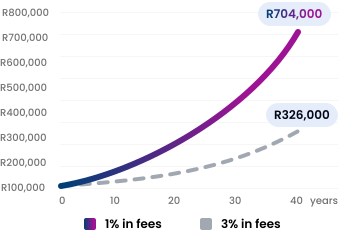
There are many companies that charge more than 3% per annum for a retirement annuity. While 3% doesn’t sound like a lot, the negative compounding effect is monstrous, when you consider that a seemingly small 0.5% difference in net returns can result in 21% more money after 40 years! The worst part is that there are many investors who don’t even know that they are paying 3% or higher.
You can easily find out what your total fee is by asking your investment provider for your EAC (Effective Annual Cost). If you are paying 3% and looking to minimise your fees to maximise your returns, there are investment companies that charge less than 1% p.a. You can try our EAC calculator to easily see if you can make any savings on fees.
Higher fees very likely means lower returns (and here's the maths to prove it)
Paying high fees on your retirement investments (such as a retirement annuity or a living annuity) almost always means less money in your pocket, and less money for your retirement. Read more
If you want to know more about any of the above, you are more than welcome to chat to 10X. We are here to help.
Related articles


How can we 10X Your Future?
Begin your journey to a secure future with 10X Investments. Explore our range of retirement products designed to help you grow your wealth and achieve financial success.